
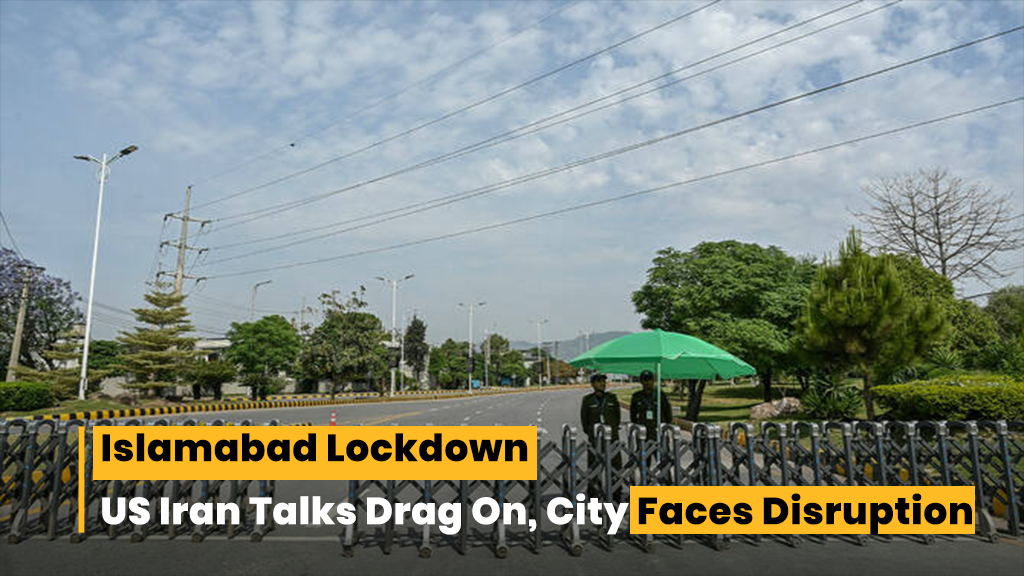
Islamabad has been under a pandemic-style lockdown for days not because of a virus, but because diplomacy keeps stalling. And it is ordinary people who are paying the price.
- 6+ Days locked down
- 7h Daily power cuts
- 50% Taxi income lost
- 230mi Exam relocated
Walk through Islamabad on any given morning and you already know something is wrong. The streets, normally buzzing with commuters and vendors, with rickshaws competing for space, are empty. Shops are shuttered. Public transport has vanished. The city breathes, but barely.
For more than six days now, Pakistan’s capital has been living under an extraordinary lockdown, one not imposed by a pandemic or a natural disaster, but by the shadow of geopolitical uncertainty. U.S.-Iran negotiations, which were supposed to transform the region’s diplomatic landscape, keep being announced and keep not happening. And as the world’s diplomats play their waiting game, the people of Islamabad are left frozen in place.
“I have not earned a single rupee in six days. My children are asking me why there is no food.”
That is the kind of sentence that does not appear in diplomatic readouts. It comes from a daily wage laborer, one of thousands across the city who live paycheck to paycheck or more accurately, day to day. No work means no money. No money means no food. The equation is that simple, and that brutal.
Streets and commerce
Shops shuttered, public transport closed, workers ordered home. The city’s economic engine has been switched off by government decree.
Evictions
On Saturday, thousands of hostel residents were evicted on government orders. Many were given no warning and no alternative left to scramble for shelter in a city already in lockdown.
Power crisis
Up to seven hours of power cuts daily. Fuel shortages, triggered by the closure of the Strait of Hormuz, have cascaded down to household electricity, a global crisis landing in living rooms.
Livelihoods
Taxi drivers report their earnings have been cut in half. Daily wage workers have gone six or more days without work or food.
Civil services
Exams for 1,200 civil service candidates, a milestone for many families, were abruptly relocated 230 miles away to Lahore, pending months of preparation at the last minute.
The diplomacy of waiting
There is something almost surreal about this situation. A city of millions is living in suspension not because of something that happened, but because of something that might. The U.S.-Iran talks carry enormous weight for the region: energy prices, sanctions, and the flow of goods through the Gulf. Pakistan sits downstream of all of it.
But downstream is a comfortable metaphor. What is happening in Islamabad right now is not comfortable at all. The Hormuz closure, a direct consequence of the same diplomatic standoff, has already strangled fuel supplies enough to force rolling blackouts. The city is, in a very literal sense, running on empty.
The capital is paying a real, grinding, daily price for negotiations happening in rooms it has no seat in.
The civil service exam situation deserves particular attention. For 1,200 young Pakistanis, that exam represented years of preparation, a shot at stability, a future. Moving it 230 miles away with little notice is not a minor administrative inconvenience. For candidates who cannot afford last-minute travel, accommodation, or who have families and jobs tethering them to the city, it may effectively mean missing it altogether.
Who counts as collateral?
Every major geopolitical event produces what analysts call “spillover effects.” It is a tidy phrase. It smooths over the reality of what spillover actually looks like: a taxi driver sitting in an empty cab, wondering how to explain to his children why there is no dinner. A hostel resident carrying their belongings down a locked-down street with nowhere to go. A laborer staring at idle hands on day six.
Islamabad is not a warzone. It is not even adjacent to one. But the machinery of great-power diplomacy, its delays, its leverage games, its controlled uncertainty has a blast radius that extends far beyond the negotiating table. Right now, that radius covers an entire capital city.
The talks, whenever they happen, will be covered extensively. There will be press conferences and handshakes and analysis. What will receive far less coverage is the moment the lockdown finally lifts and the people of Islamabad begin counting what they lost in the waiting.