
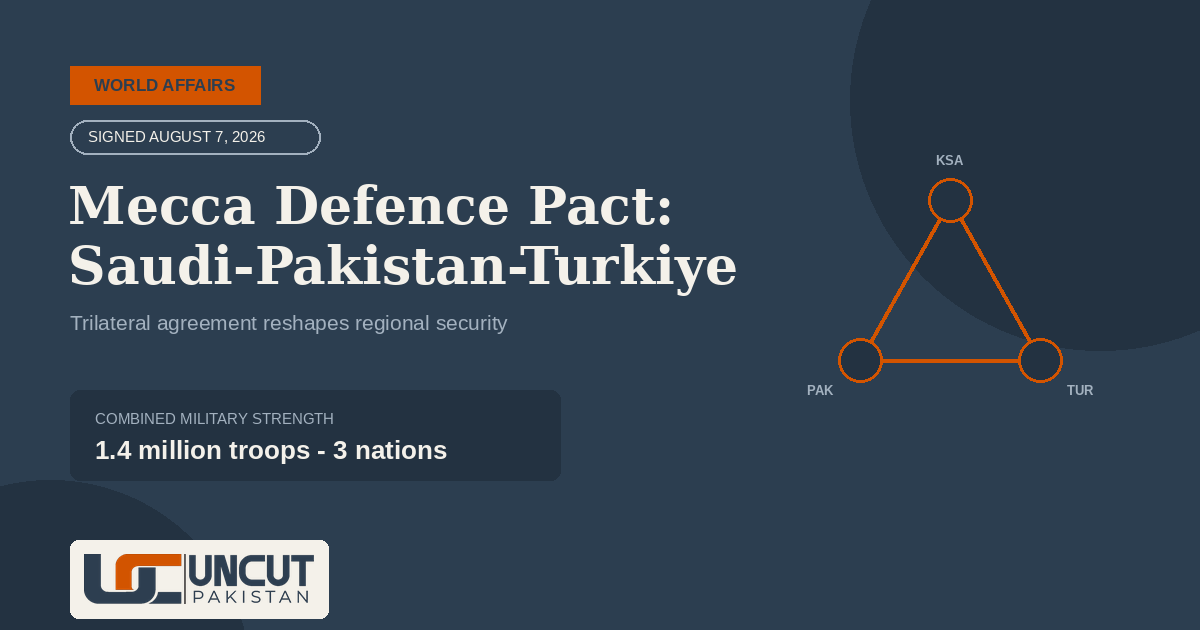
Mecca: On August 7, Saudi Arabia, Pakistan, and Turkiye signed a trilateral defense pact known as the Mecca Joint Defense Agreement. Saudi Crown Prince Mohammed bin Salman, Turkish President Recep Tayyip Erdogan, and Pakistan’s Prime Minister Shehbaz Sharif all signed the deal in person.
In Islam’s holiest city, signing the contract has symbolic importance of its own. Although all three nations had bilateral defense ties, this is the first time they have gathered under a single official collective security structure.
What’s Actually in the Agreement?
The three nations promised to keep boosting their shared security and to advance peace, security, and stability in the area, according to the joint statement. Pakistan’s Foreign Ministry explained that an attack on one member would be regarded as an attack on all three, therefore creating a collective deterrence strategy.
Why Now?
The timing tracks back to growing regional conflicts. The fear of a resurgent Iran conflict, Houthi raids from Yemen, and declining certainty throughout the Gulf regarding US security guarantees all drove Saudi Arabia to strengthen its deterrence strategy.
Though less exposed to the conflict directly, Pakistan and Turkey have developed worry about regional volatility as well. The deal itself is the result of almost a year of negotiations.
By the numbers, how large is this coalition?
The 2026 Global Firepower Index estimates that the three nations together have approximately 1.4 million active military personnel, 3,400 aircraft, 6,000 tanks, and over 340 naval assets. As the only nuclear-armed country in the Muslim world, Pakistan, Turkiye with NATO’s second-biggest army, and Saudi Arabia as a leading oil exporter make that combination a major security alliance throughout the Middle East and South Asia.
Is this comparable to NATO?
Experts say no; this is not an official military alliance on the size of NATO, but it is no less important. Defence experts observe that Pakistan’s nuclear attitude will probably remain centered on the perceived danger from India, and that the pact does not broaden Pakistan’s nuclear deterrence to include Saudi Arabia or Turkey. It’s more about improving defence sector connections and diplomatic cooperation among the three instead.