
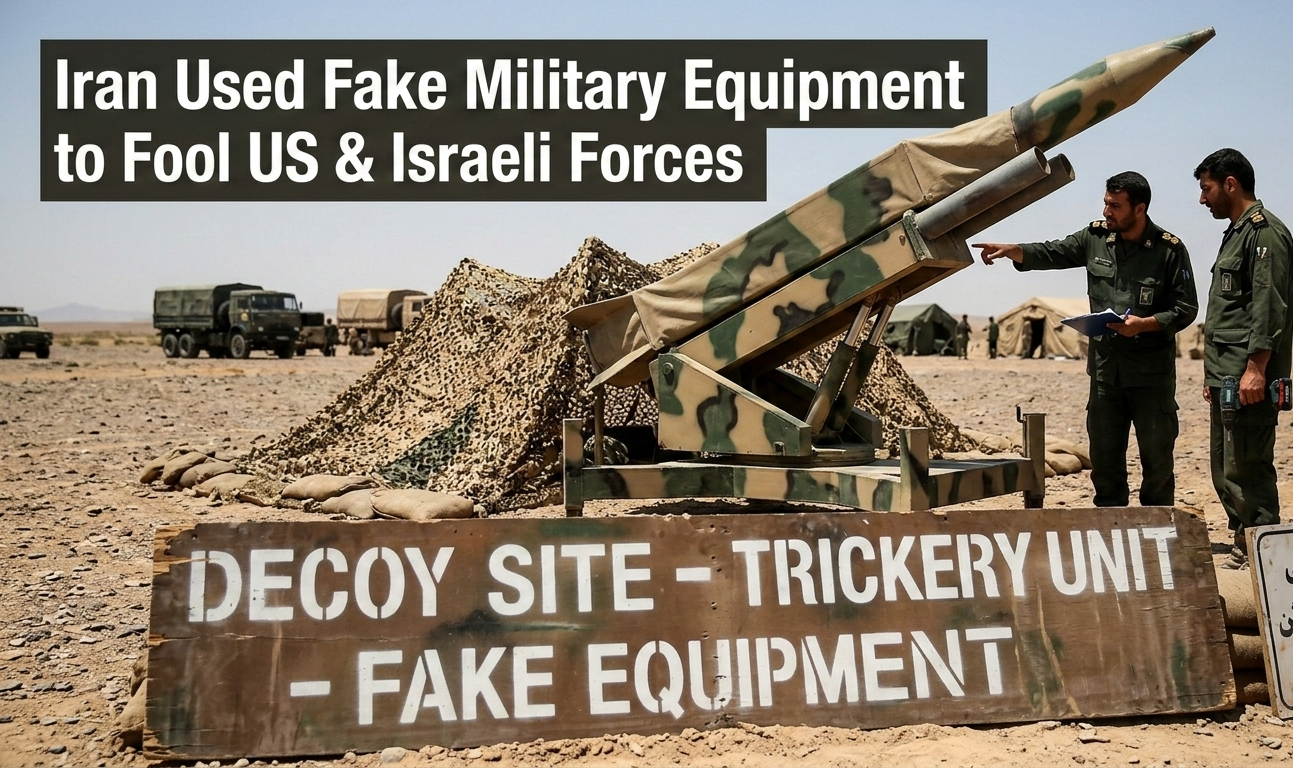
Iran Fake Military Equipment has become a major topic of discussion in global defense circles after reports suggested that Iran used fake military assets to confuse US and Israeli forces during surveillance and potential strike operations. The use of decoy weapons and dummy equipment highlights a new dimension of modern military strategy, where deception can be just as powerful as advanced weapons.
According to defense analysts, Iran may have deployed fake fighter jets, helicopters, missile launchers, and tanks to mislead enemy surveillance systems. These decoys were designed to appear real when viewed from satellites, drones, or reconnaissance aircraft. As a result, high-value missiles could be wasted on targets that were not actually operational military equipment.
How Iran’s Decoy Strategy Worked
According to reports circulating online and in defense analysis circles, Iran deployed inflatable or painted military equipment designed to look like real weapons from the air. These decoys included:
- Fake fighter jets
- Dummy helicopters
- Inflatable tanks
- Mock missile launchers
From satellites, drones, or high-altitude aircraft, these decoys can appear identical to real equipment. As a result, US and Israeli forces may mistakenly strike fake targets, wasting precision-guided missiles worth hundreds of thousands of dollars.
Some reports even claim that thermal paint was used to imitate heat signatures, making fake aircraft appear real to infrared surveillance systems.
Viral Video Sparks Debate
The controversy gained global attention after a viral video showed a missile striking what looked like a helicopter on an Iranian airstrip. Some online observers argued that the target might have been a painted decoy rather than a real aircraft.
The footage triggered intense debate on social media, with analysts questioning whether the strike destroyed a real military asset or simply a cleverly designed illusion.
Why Fake Military Equipment Works
Using decoys in war is not new, but modern technology has made these tactics even more effective. The main goals of deploying fake equipment include:
- Protect real military assets by hiding them in secure locations.
- Confuse enemy intelligence and surveillance systems.
- Force opponents to waste expensive missiles on fake targets.
- Create uncertainty about battlefield damage assessments.
Experts say such tactics can significantly increase the cost of military operations for attacking forces while preserving Iran’s real defense systems.
The Rise of Deception in Modern Warfare
Military deception has been used throughout history, from World War II inflatable tanks to modern digital misinformation campaigns. However, today’s conflicts combine traditional tricks with advanced technology, satellite imagery, and cyber warfare.
In the current Middle East conflict, analysts also warn that AI-generated images and manipulated satellite photos are spreading online, making it harder to determine what is real and what is propaganda.
What This Means for Future Conflicts
If these reports are accurate, Iran’s strategy demonstrates that simple, low-cost deception can challenge high-tech military systems. It may force countries like the United States and Israel to invest more in verification technology and intelligence gathering before launching strikes.
The incident also shows that modern warfare is no longer just about weapons—it is about information, perception, and psychological strategy.
Conclusion
Iran’s alleged use of fake military equipment highlights how modern conflicts are evolving. By combining traditional decoys with advanced camouflage techniques, Iran may have successfully forced powerful militaries to waste expensive weapons on fake targets.
Whether these claims are fully verified or partly propaganda, the story reveals a crucial lesson: in modern warfare, deception can sometimes be as powerful as firepower.





The winning streaks here are insane. I managed to hit a big jackpot last night and the withdrawal was processed instantly. High praise for krcasinowinoui
A hidden gem for sure. The game selection is top notch and the win rate feels fair. Check out brttt7774 if you are looking for something fresh.
I really appreciate how straightforward this place keeps things. The banking options cover all my usual methods and the VIP tier system actually rewards loyal players with perks that matter. Game library is massive and I love that they add new titles every week. A trustworthy spot for both casual fun and serious play. pebitelbet
Very user friendly layout and the promotions are actually worth it. I feel lucky whenever I log in here. Check out luky97login