
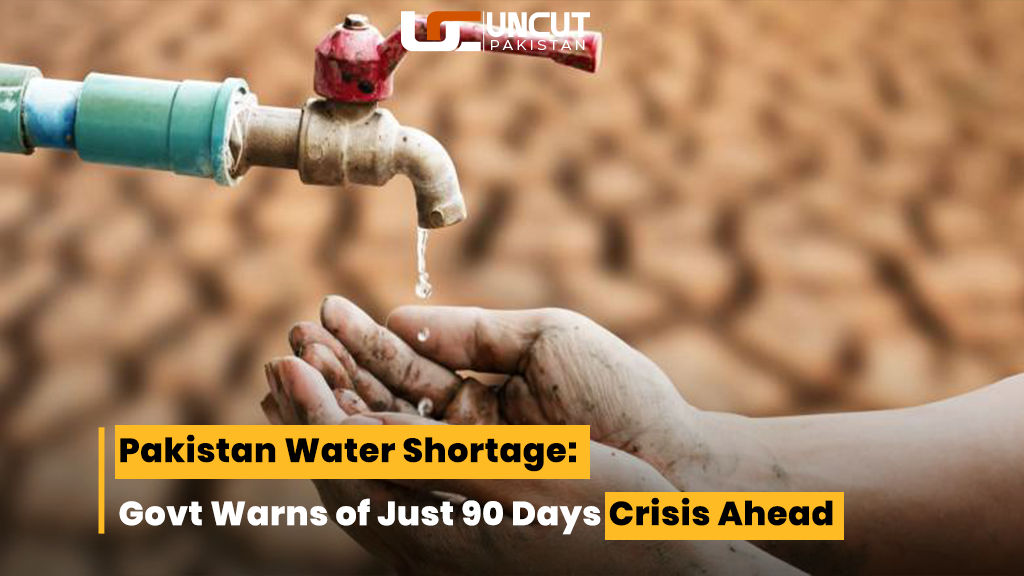
The government just confirmed what water experts have been warning about for years: Pakistan can only store roughly 90 days’ worth of water. For a country of 250 million people, that number should make everyone stop and think.
When the government issues a warning about water, most of us scroll past it. It sounds distant, bureaucratic, someone else’s problem. But this one is different, and the number is damning: 90 days.
Read More: Economic Challenges in Balochistan Despite Its Resource Wealth
On April 30, 2026, Pakistan’s Ministry of Planning and Development officially stated that the country’s water storage capacity stands at around 90 days far below the 120-day benchmark maintained by comparable regional economies and a global standard of roughly 300 days. In plain terms, if the rains stopped tomorrow and the rivers ran dry, Pakistan would run out of stored water in three months.
- 90 Days of water storage Pakistan currently has.
- 300 Days the global benchmark for water security.
- 899 m³ Per capita water availability in 2026 below the scarcity line.
- 93% Of Pakistan’s freshwater is used by agriculture alone.
How did we get here?
This didn’t happen overnight. Back in 1951, every Pakistani had access to around 5,260 cubic meters of water per year. Today that figure has collapsed to roughly 899 cubic meters, well below the 1,000 cubic meter threshold that the United Nations uses to define a water-scarce nation. The water didn’t disappear. The population grew, the infrastructure didn’t keep pace, and the climate grew more unpredictable.
Pakistan’s agriculture accounts for 93% of the country’s freshwater consumption, yet productivity remains low because farmers are still using irrigation methods that waste enormous amounts of water. Meanwhile, population growth continues at a pace that infrastructure simply cannot absorb. And with glaciers retreating and monsoon patterns becoming erratic, the rivers and snowmelt that the country has always relied upon are no longer as predictable as they once were.
The India dimension nobody is ignoring
Things got considerably more complicated last year when India suspended the Indus Waters Treaty, a 1960 World Bank-brokered agreement that has governed how the two countries share the Indus river system for over six decades. India cited the Pahalgam militant attack in Indian-administered Kashmir as justification. Pakistan denied any involvement.
Whatever the politics, the consequences for water security are stark. Pakistan can only store about 90 days’ worth of water. If India ever chose to manipulate upstream river flows during drier months, the downstream impact could be devastating drought-like conditions in agricultural zones that feed millions of people. The water crisis is no longer just a management problem. It has become a geopolitical vulnerability.
“New water reserves must be viewed as the basis of national survival rather than a subject of political debate.” Planning Minister Ahsan Iqbal.
What’s actually at stake?
When people talk about water shortages, it’s easy to imagine empty taps and long queues. But the reality goes much deeper than that. Agriculture is the backbone of Pakistan’s economy and agriculture runs on water. When water is scarce, crops fail. When crops fail, food prices spike. When food prices spike, the families who can least afford it suffer most. The domino effect is swift and brutal.
The public health dimension is equally grim. Already, close to 80% of Pakistanis don’t have access to safe drinking water. Waterborne diseases, cholera, typhoid, dysentery claim tens of thousands of lives annually, and children bear the worst of it. In cities like Karachi, residents in many localities have no choice but to buy water from private tanker operators at extortionate prices, simply to have enough for cooking and bathing.
The government’s plan and whether it’s enough
Planning Minister Ahsan Iqbal addressed a high-level roundtable consultation on national water security at the end of April, laying out a multi-part strategy. The plan calls for building large, medium and small dams, recharge dams, floodwater reservoirs, hill torrent management systems, and urban rainwater harvesting networks. A high-level task force meeting has also been announced to coordinate efforts across provinces and departments.
The minister framed it well Pakistan’s water problem isn’t just about not having enough of it. It’s also about mismanagement. The country floods in July and runs dry by March. Capturing that monsoon surplus and banking it for lean months is something that larger countries figured out decades ago. Pakistan is still catching up.
Will the plan work? That depends on whether it gets funded, whether it survives political transitions, and whether the provinces can set aside turf battles long enough to act in a unified way. Pakistan has had water policies before. Implementation has always been the harder part.
What can ordinary people do?
It’s tempting to feel helpless when a problem operates at the scale of glaciers and rivers and international treaties. But individual behavior does matter especially in cities, where water wastage is rampant. Simple things like fixing leaking taps, not leaving water running during wudhu or washing, and using buckets instead of hosepipes for car washing, and reporting water theft or illegal boring actually add up at scale.
More importantly, citizens can hold elected representatives accountable. Water security should be a central question in every local and national election campaign. Ask your MNA or MPA: what is your position on dam construction? What is being done to fix leaking urban water infrastructure? Where is the budget for rainwater harvesting going?
Final Thoughts
Ninety days. That’s all the buffer Pakistan has between itself and a water emergency. Not 300 days like global standards suggest. Not 120 like regional neighbors manage. Just 90 and the climate isn’t getting kinder, the population isn’t shrinking, and the Indus Waters Treaty that kept upstream flows predictable is now suspended.
This isn’t a slow-moving problem you can revisit in a decade. It’s a crisis that’s already arriving at Pakistan’s doorstep in dry canals in Sindh, in broken water pipelines in Quetta, in the children who miss school because they’re sick from contaminated water. The government has acknowledged the scale of it. The question now is whether that acknowledgement turns into action fast enough to matter.
Pakistan is not short on solutions. It is short on time.




1 thought on “Pakistan Has Just 90 Days Of Water Shortage, Govt Warns”
Comments are closed.