
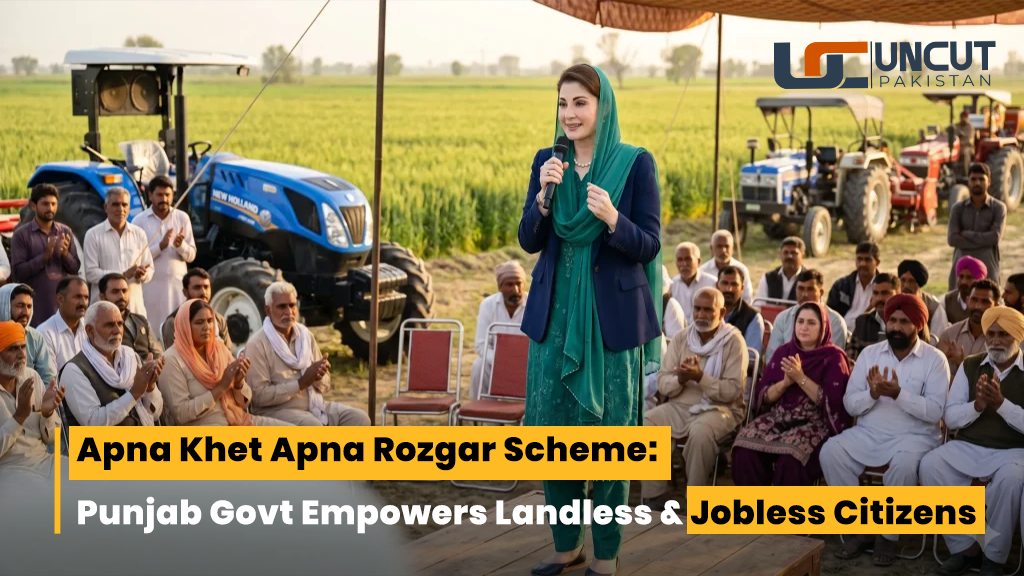
In a move that could reshape agrarian life across the province, Chief Minister Maryam Nawaz has formally launched the Apna Khet, Apna Rozgar (Own Field, Own Livelihood) scheme officially titled “Apni Zameen, Apni Mehnat, Apni Fasal or Apna Rozgar” along with an online portal to receive applications. The initiative targets one of Punjab’s most persistent inequalities: the landless rural poor who toil on others’ fields but have no stake in the soil they farm.
The scheme is part of a broader wave of welfare initiatives under CM Maryam Nawaz, following the popular Apni Chhat Apna Ghar housing programme. Where that scheme addressed urban homelessness, this one turns its attention to the countryside aiming to break the cycle of rural poverty through direct access to cultivable land.
“Maryam Nawaz does not make claims but does practical work. Farmers have been provided with facilities like Kisan Card, Green Tractor, Super Seeder and Tube Well Solarization, which led to record wheat production in Punjab. “Punjab Information Minister Uzma Bukhari”
What the scheme offers
At its core, the scheme distributes cultivable government land identified on the basis of water availability and soil fertility to landless rural families on a 10-year lease strictly reserved for agricultural use. No permanent construction is permitted on the allotted land, ensuring it remains productive farmland for the duration of the lease.
Start-up grant:
One-time grant of Rs 50,000-Rs 250,000 per acre to begin cultivation.
10-year lease:
Secure tenure for farming families to build sustainable livelihoods.
Online portal:
Full digital registration no agents, no middlemen required.
Across Punjab’s districts, a total of 13,812 agricultural plots will benefit 88,780 families. In the Cholistan desert region, an additional 16,685 plots are earmarked for 101,111 families recognizing that some of the province’s poorest communities live in this arid belt, where properly irrigated land can be transformative.
Part of Punjab’s Broader Agricultural Strategy
The scheme does not stand alone. It fits squarely into a broader agricultural transformation the Punjab government has been building: the Kisan Card for direct farmer subsidies, Green Tractor schemes, Super Seeder distribution to fight stubble burning, and Tube Well Solarization to cut energy costs. Together, these have contributed to what officials describe as record wheat production in the province.
Apna Khet, Apna Rozgar adds the most fundamental missing piece to this policy architecture land itself. Subsidized tractors and farming cards help those who already farm their own plots; this scheme extends the benefit to those who have been left entirely outside the agricultural economy despite living within it.
The Board of Revenue’s Senior Member Nabeel Javed confirmed that land selection will be rigorous assessed specifically for water supply and soil quality so beneficiaries receive genuinely productive holdings rather than marginal waste land.
How to apply
- Check your eligibility: Applicants must be permanent residents of Punjab with a valid CNIC, be landless, and preferably unemployed or active farmers without land of their own.
- Visit the official portal: Applications open from May 2 to May 18, 2026 exclusively through the government’s online portal. No agent or private website is authorized to collect applications.
- Prepare your documents: Have your CNIC, proof of residence, and any supporting agricultural documents ready before you start applications cannot be changed after submission.
- Submit and track: Once submitted, track your application status online. Approval depends on eligibility, land quota, and evaluation by Board of Revenue officials.
Read More: Govt announced a free online German language program
Why this matters
Pakistan’s rural poor have long been caught in a structural trap: without land, you cannot farm independently; without farming income, you cannot afford land. Tenancy arrangements and absentee landlordism have perpetuated this cycle for generations, particularly in southern Punjab and Cholistan.
If implemented with transparency and administrative efficiency, Apna Khet, Apna Rozgar could be one of the most consequential rural welfare interventions in the province’s recent history. Nearly 190,000 families roughly a million people stand to gain direct access to productive farmland for the first time. The pairing of land with a start-up cash grant is especially important: it gives new farmers the capital to plant their first crop rather than immediately falling into debt.
The real test, of course, will be in execution: whether land is distributed fairly, whether soil and water assessments hold up in practice, and whether the lease framework protects beneficiaries from dispossession. Civil society, journalists, and the communities themselves will need to hold the process accountable every step of the way.
But the ambition is real and for the landless farmers of Punjab, the window is now open.