
Rawalpindi/Islamabad, August 20, 2026: What started as ordinary monsoon showers on Monday, August 17 has turned into one of the more disruptive flooding episodes the twin cities have seen this season. By Wednesday, August 19, Rawalpindi’s historic Raja Bazar was underwater, shopkeepers were wading through flooded lanes to save their stock, and authorities were sounding sirens along Nullah Lai as water levels climbed past the danger mark. As of Thursday, August 20, the Pakistan Meteorological Department (PMD) says the system still hasn’t fully moved on.
Here’s a full timeline of how the situation developed, where things stand right now, and what residents of Rawalpindi and Islamabad should expect over the coming days.
How It Started: August 17
The trouble began on Monday, August 17, when PMD issued its weekly weather outlook covering August 17-23, warning of rain, wind and thundershowers across Islamabad, the Pothohar region, northeast Punjab, Kashmir and Gilgit-Baltistan. That same day, rain intensified across Rawalpindi and Islamabad, and WASA’s Managing Director Aziz Ullah Khan confirmed that water levels in Nullah Lai had already risen to 10.5 feet at Katarian and 8.5 feet at Gawalmandi. Shamsabad recorded the heaviest rainfall in Rawalpindi that day, at 116mm.
Even at this early stage, WASA declared a rain emergency and began deploying heavy machinery to known trouble spots — Liaquat Bagh, the Committee Chowk underpass, Murree Road, Dhoke Khabba, Circular Road and Sadiqabad — as a precaution.
The Situation Escalates: August 18-19
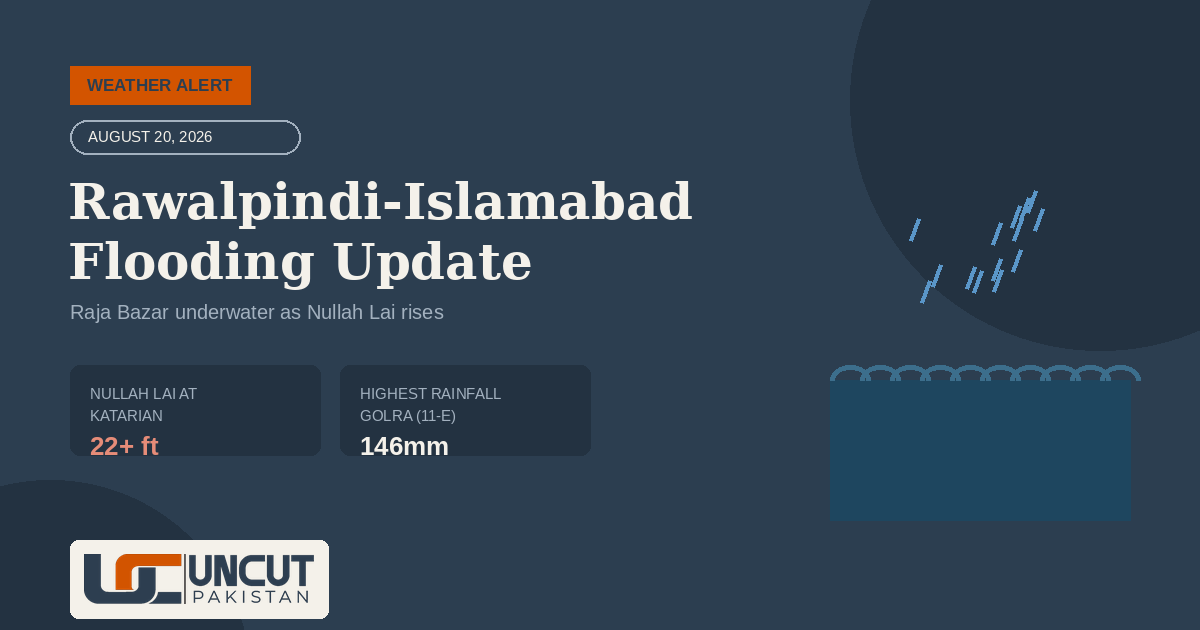
By Tuesday, August 18, conditions had worsened considerably. Golra (11-E) recorded the highest rainfall in the twin cities at 146mm, followed by Bokra at 138mm, Pirwadhai at 105mm, and Gawalmandi at 77mm. The Nullah Lai water level near Gawalmandi Bridge rose to roughly 15 feet, and floodwater began entering homes in Dhoke Khabba and Sadiqabad.
Things came to a head on Wednesday, August 19, when water levels at Katarian crossed 22 feet — a mark serious enough for authorities to sound warning sirens and formally advise residents living along Nullah Lai to relocate to safer ground if needed. This was also the day Raja Bazar itself went underwater, with visuals circulating online showing the market’s narrow lanes turned into knee-deep waterways. PMD’s automatic weather stations recorded Saidpur as the highest-rainfall location that day, at 66mm, while an active weather system centred over Islamabad and Gujar Khan continued feeding fresh showers into the region.
Where Things Stand Today: August 20
As of Thursday, August 20, PMD says the threat hasn’t passed. In a fresh alert, the department warned of further rain and thunderstorms expected in Islamabad, Rawalpindi, Taxila, Wah Cantt, Attock, Jhelum, Murree, Kallar Syedan and Gujar Khan within the next two to four hours, cautioning that renewed heavy downpours could cause further water accumulation in low-lying areas and push Nullah Lai’s level up again.
WASA has kept its rain-emergency footing in place, with teams and heavy machinery still stationed across the city’s known flood points.
Areas Worst Affected So Far
Based on WASA’s on-ground reporting over the past three days, the following areas have seen the most disruption:
- Raja Bazar — Rawalpindi’s main commercial market, flooded and largely inaccessible
- Dhoke Khabba — floodwater entered multiple homes
- Sadiqabad — among the worst-hit low-lying residential pockets
- Fauji Colony and Mumtaz Town — flooding reported in low-lying sections
- Liaquat Bagh and Committee Chowk underpass — under close WASA monitoring
- Circular Road and Gawalmandi — water accumulation and rising Nullah Lai levels
What Happens Next?
PMD’s weekly outlook, which runs through Saturday, August 23, suggests this won’t be a quick clear-out. Rain and thunderstorm activity is expected to persist across Islamabad, Pothohar, northeast Punjab, Kashmir and Gilgit-Baltistan for the rest of the week, meaning residents of the twin cities likely have a few more uncertain days ahead before conditions genuinely stabilise.
Safety Advisory for Residents
With the situation still active, authorities have repeated the same core advice:
- Avoid unnecessary travel, especially through low-lying or underpass areas
- Stay well away from electricity poles and open nullahs
- Contact the WASA helpline immediately in case of emergency
- Residents near Nullah Lai should take precautionary measures and be ready to move if water levels rise further