
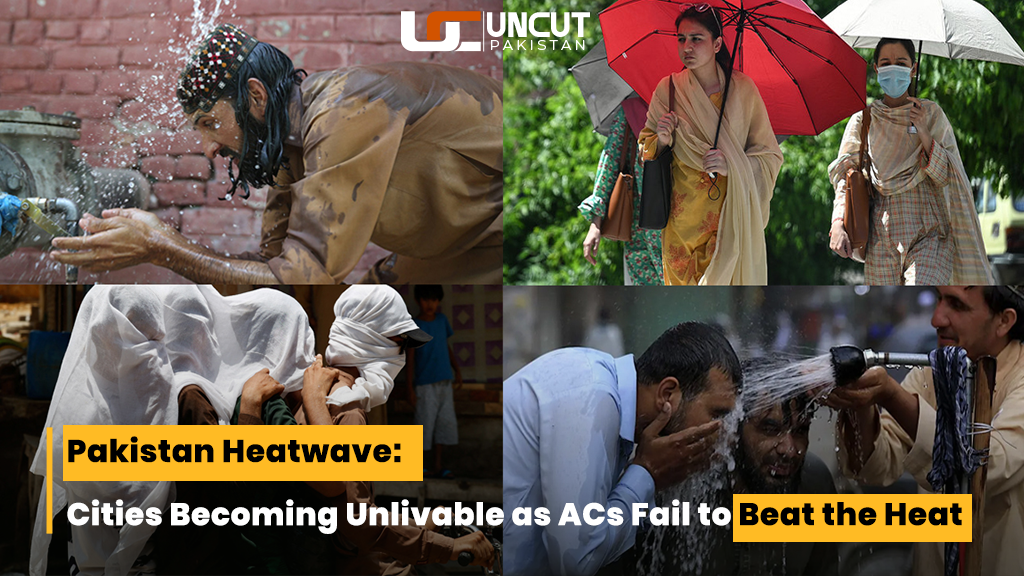
If you step outside in Karachi on a hot June afternoon, the heat feels very strong and almost hard to deal with. The air is not just hot it feels heavy and uncomfortable. Because of the humidity, it feels like a wet cloth is stuck on your face.
The ground is so hot that it sends heat back up at you, while the sun is also burning down from above. Shade doesn’t really help much. There is also no cool sea breeze like before, because the growing city blocks the air from moving freely. Even if you manage to go back inside to an air-conditioned room, the electricity might not be working, so you could still end up sitting in the heat.
- 47.2°C Peak temp in Karachi, June 2024.
- 568 Bodies received by Edhi in just 5 days.
- 40M+ Pakistanis facing dangerous heat over half the year.
This is Pakistan’s new summer reality. Not a crisis that’s coming, one that is already here, already killing people, and already pushing the country’s cities to the edge of what human bodies and broken infrastructure can handle together.
When the heat itself becomes the enemy
Pakistan has always been hot in temperature but what scientists have been watching with growing alarm is how the nature of that heat has changed. It used to be bearable in the shade and cool down at night. Cities like Jacobabad and Hyderabad are now projected to have several months each year when conditions are so extreme that even people sitting in the shade face serious health risks. Jacobabad, already considered one of the hottest inhabited places on earth, has recorded temperatures above 120°F (about 49°C), with night time lows staying in the 90s Fahrenheit. There is no recovery window. The body never gets a chance to cool down. Hour by hour, the heat debt accumulates, and eventually the body just stops coping.
Peak recorded temperatures selected Pakistani cities
- Jacobabad 49°C
- Karachi 47.2°C
- Lahore 43°C
- Multan 46°C+
The number of Pakistanis exposed to a full month of inescapable, dangerous heat, the kind that kills even in the shade, is projected to be four times higher in 2030 than it was at the turn of the millennium. And by 2050, the number of people globally suffering through such conditions could reach 1.3 billion. Pakistan will be carrying a disproportionate share of that burden.
The urban heat trap
If you want to understand why Pakistan’s cities are heating up faster than the countryside, stand in the middle of any major Pakistani city and look around. Concrete. Asphalt. Steel. Glass. Building after building with virtually no green space between them. The materials that make cities feel modern and solid also happen to be excellent at absorbing heat during the day and radiating it back through the night.
This is called the urban heat island effect, and in Pakistan it has been quietly cooking cities for decades. Since 2000, concrete has claimed nearly 80 percent of Karachi’s green cover. In Lahore and Multan, agricultural land and mango orchards have been razed for housing schemes and commercial plazas. The trees are gone, the shade is gone, and the natural cooling is gone. What’s left is a heat trap that the planet’s rising baseline temperatures are only making worse.
“It’s not about air conditioning your way out. It’s about creating a culture of preparedness and that hasn’t happened yet.” Former Pakistan climate change minister
And the city populations keep growing fast. Pakistan has the highest urbanization rate in South Asia. Pakistani cities expanded by up to 5.87% in land area between 2001 and 2022, but population growth in those same cities ranged from 51% to over 125%. More people packed into denser, hotter, less green urban spaces, with the same aging grid expected to power it all through the worst heat Pakistan has ever experienced.
Who actually suffers?
It is never the people with generators who die in a heatwave. Let’s be clear about that. The people filling up hospital wards in Karachi every June are the elderly, day laborers, street vendors, construction workers, rickshaw drivers, and the homeless. People who cannot afford air conditioning, who work outdoors, who live in kachi abadis with tin roofs that become ovens by noon.
In heatstroke wards across Sindh, nurses have reported a 20 percent year-on-year increase in patients over the last five years. On a 109-degree day in a government hospital in central Sindh, babies were wailing and adults were vomiting into buckets in a room with seven beds meant to serve a ward of hundreds. Two air conditioners chugged along whether they’d stay on depended on whether the electricity held.
Women face particular hidden risks. Cultural norms often restrict movement, meaning women in conservative households can’t sit by open windows or move around freely for ventilation. A midwife running a clinic on Karachi’s Baba Island reported rising second-trimester pregnancy losses. A 2026 study found that 9 to 13 percent of low birth weight cases in Pakistan were directly attributable to heat exposure. The heat is not just killing people, it’s affecting the next generation before they’re even born.
The invisible death toll
One of the most disturbing aspects of Pakistan’s heat crisis is how well hidden it is statistically. Heatwaves are called “silent killers” for a reason. When a laborer collapses in the street, it gets recorded as a fall. When an elderly person’s heart gives out in a stifling apartment, it goes down as cardiac arrest. The heat that caused both deaths disappears from the paperwork entirely.
The Edhi Foundation which runs Pakistan’s largest ambulance service received 568 bodies over just five days in June 2024, against a daily average of around 40. Official death tolls during that same period were a fraction of that number. The 2015 Karachi heatwave, which is the most documented in recent memory, officially killed around 1,200 people. Researchers believe the actual toll was significantly higher. The gaps in Pakistan’s disaster data infrastructure mean we likely will never know the true scale of what has already happened, let alone what is coming.
What can actually be done?
The solutions that get discussed are rarely the ones that get implemented. Urban greening, planting trees, creating parks, and preserving open land is one of the cheapest and most effective tools for reducing urban heat, but it competes with the land values that drive Pakistan’s construction economy. Cool roofs, which reflect heat instead of absorbing it, can cut indoor temperatures meaningfully, but mass adoption requires subsidy programs that haven’t materialized. Low-tech interventions cotton clothing, spray bottles, damp washcloths, hand fans, and shade canopies were shown in trials at Aga Khan University to cut indoor temperatures by 3 to 4 degrees Celsius. That’s significant. Those tools cost almost nothing. But distributing them at scale, reaching the most vulnerable households, requires a public health infrastructure that’s still being built.
Solar-powered air conditioning is quietly gaining ground as a long-term answer. The irony of using the sun, the very thing trying to kill everyone to power the cooling that keeps people alive is not lost on anyone. But solar AC doesn’t solve the grid crisis tomorrow. It doesn’t help the family in Lyari whose landlord won’t allow roof modifications, or the widow in Orangi who can’t afford even a basic solar panel.
What’s needed, ultimately, is for Pakistan’s governments federal, provincial, and municipal to start treating summer heat as the emergency it already is, not the inconvenience it used to be. Heat action plans exist on paper. Early warning systems have been piloted. But the follow-through, the coordination, and the sustained investment that’s where it keeps falling apart.
Pakistan’s summers are no longer just uncomfortable. They are actively dangerous. And until the country and the world treats them that way, every June will be a quiet emergency that most people will never see in the official numbers.
Read More: Pakistan Has Just 90 Days Of Water Shortage, Govt Warns